Can You Sue the VA for Malpractice? Yes — Under the FTCA
Our VA medical malpractice lawyers prepare the administrative claim required by the Federal Tort Claims Act, normally using Standard Form SF-95 — within two years after the claim accrues (28 U.S.C. § 2401(b)). A doctor-attorney team, $145M+ recovered across 600+ cases in all 50 states.
Free Case EvaluationWritten and legally reviewed by Dr. Michael Archuleta, J.D./M.D. · Last reviewed
VA medical malpractice lawyers represent veterans whose care at a Department of Veterans Affairs hospital or clinic fell below the accepted standard and caused injury or death. Claims arising from negligent care by federal employees acting within the scope of their employment may proceed under the Federal Tort Claims Act (28 U.S.C. § 1346(b)), which uses applicable state law to determine liability and damages. Provider employment status and statutory exceptions can affect whether the FTCA applies. The Feres Doctrine does not bar veterans from suing the VA; it applies only to active-duty injuries incident to service. Veterans must present an administrative claim, normally using Standard Form SF-95 with the VA's Office of General Counsel within two years after the claim accrues (28 U.S.C. § 2401(b)). Our VA medical malpractice attorneys have handled this process for 25+ years. Our reported settlement averages describe past cases; they do not establish what caused differences between claimant groups or predict the outcome of a new claim.
Accrual generally depends on when the injury and its cause were known or reasonably should have been known. The agency must receive SF-95 or other qualifying written notice with a sum certain under 28 C.F.R. § 14.2. Missing a deadline can bar a claim, but United States v. Wong permits equitable tolling in limited circumstances. Seek advice promptly, even if you believe a deadline has passed.
Understanding the review
Three questions that shape a review.
The care setting, the medical record, and the applicable legal rules each contribute to understanding a potential claim.

Explore the questions
Care contextWhere and by whom was care provided?
The facility, the provider’s employment status, and the circumstances of treatment help identify which legal rules may apply.
Useful to knowThe facility name, approximate dates, and people involved are a useful starting point.
Medical recordsWhat does the record help explain?
Treatment notes, test results, referrals, and follow-up records help connect the sequence of care and identify questions that need closer review.
Useful to knowDescribe the treatment and changes in condition you remember. Records can help fill in the sequence.
Legal optionsWhich questions need legal review?
A potential claim requires review of the standard of care, causation, and the relevant claim requirements. The available route depends on the circumstances.
Useful to knowEligibility, filing requirements, and potential next steps need an assessment of the specific facts.
A poor outcome alone does not establish medical malpractice.
People Also Ask About Suing the VA
Short, statute-cited answers to the questions veterans most often ask before filing an FTCA claim against the VA.
Is it hard to sue the VA for malpractice?
It is procedurally strict rather than rare. You cannot begin in court: the VA must receive a written administrative claim, normally Standard Form SF-95, within two years after the claim accrues (28 U.S.C. § 2401(b)), and the agency then has six months to act before suit may be filed (28 U.S.C. § 2675(a)). Liability is measured by the standard of care of the state where the treatment was given (28 U.S.C. § 1346(b)(1)), so independent expert medical testimony is normally required, and a federal judge rather than a jury decides the case (28 U.S.C. § 2402). Veterans treated at VA facilities may bring these claims; active-duty servicemembers injured incident to service are generally barred by the Feres doctrine (Feres v. United States, 340 U.S. 135 (1950)).
Can I file a lawsuit against the VA?
Not as a first step, and not against the VA itself. The Federal Tort Claims Act requires you to present an administrative claim to the agency before any suit (28 U.S.C. § 2675(a)); only after the VA denies it in writing, or lets six months pass without a decision, may you go to court. The defendant is then the United States — not the Department of Veterans Affairs, and not the individual physician or nurse, whom 38 U.S.C. § 7316(a)(1) shields from personal liability for VA medical care. Suit must be filed in federal district court within six months after the denial is mailed (28 U.S.C. § 2401(b)).
How much does a VA claim lawyer cost?
Presenting the SF-95 administrative claim costs nothing to file. Attorney fees in an FTCA case are capped by federal statute rather than set by negotiation: no more than 25% of a judgment, or of a settlement reached after suit is filed, and no more than 20% of a settlement of the administrative claim (28 U.S.C. § 2678) — below the 33–40% contingency common in private personal-injury work. Charging above those statutory limits is a criminal offense under that same section. Because the cap is expressed as a percentage of the recovery, FTCA fees are ordinarily contingent. The Archuleta Law Firm charges no upfront fees; you pay only if we win.
How long does it take to sue the VA?
There is no fixed timeline, but the statute sets the milestones. After you file the SF-95, the VA has six months to reach a final disposition (28 U.S.C. § 2675(a)). If it denies the claim, you have six months from the mailing of that denial to file suit in U.S. District Court (28 U.S.C. § 2401(b)); if six months pass with no decision, you may treat the claim as denied and sue. Many claims resolve administratively, while contested cases that reach federal court take considerably longer.
Is it worth suing for malpractice?
That turns on the strength of the medical evidence, not on the cost of bringing the claim. Presenting a Standard Form SF-95 is free, and federal law caps attorney fees at 25% of a judgment or 20% of an administrative settlement (28 U.S.C. § 2678). What limits an FTCA case is the statute itself: no punitive damages (28 U.S.C. § 2674), no jury — a federal judge decides (28 U.S.C. § 2402), and a general limit on recovery above the sum certain in the administrative claim, subject to newly discovered evidence or intervening facts under 28 U.S.C. § 2675(b). That figure must be set carefully at the outset. Prior results do not guarantee a similar outcome.
What are the odds of winning a medical malpractice suit?
No published success rate predicts an individual case, and any lawyer who quotes you one is guessing. Three things decide a VA malpractice claim: whether an independent medical expert will testify that the care fell below the standard of care of the state where you were treated (28 U.S.C. § 1346(b)(1)); whether that breach — rather than the underlying illness — caused the harm; and whether the SF-95 reached the agency within two years (28 U.S.C. § 2401(b)). A claim that clears all three is worth pursuing. Prior results do not guarantee a similar outcome.
Can you sue the VA for botched surgery?
Yes. A botched or negligent operation at a VA hospital is an ordinary medical negligence claim, brought against the United States under the Federal Tort Claims Act (28 U.S.C. § 1346(b)(1)) rather than against the hospital or the surgeon. You must first present an administrative claim, normally using Standard Form SF-95, to the VA's Office of General Counsel within two years after the claim accrues (28 U.S.C. § 2401(b)).
Why can't VA doctors get sued?
Because Congress substituted the government as the defendant — not because the claim disappears. Under 38 U.S.C. § 7316(a)(1), the FTCA remedy against the United States is "exclusive of any other civil action or proceeding by reason of the same subject matter against the health care employee." You cannot name the VA physician or nurse personally, but you can sue the United States for exactly the same malpractice.
What are the four things that must be proven to win a medical malpractice suit?
Duty, breach, causation and damages. In a VA case those four elements are supplied by the law of the state where the treatment was given (28 U.S.C. § 1346(b)(1)): a duty of care owed to the patient, a breach of the accepted standard of care, proof that the breach actually caused the injury, and compensable harm. Expert medical testimony is normally required to establish the standard of care and causation.
What are the hardest VA claims to win?
The hardest are the ones defeated by a legal bar rather than by the medicine: injuries to active-duty servicemembers, which the Feres doctrine bars (Feres v. United States, 340 U.S. 135 (1950)); claims presented after the two-year SF-95 deadline has run (28 U.S.C. § 2401(b)); and cases where the records show a bad outcome but no departure from the standard of care, since causation must still be proven by expert testimony.
Does “VA malpractice” mean Virginia or Veterans Affairs?
Here it means the U.S. Department of Veterans Affairs — the federal agency that runs VA hospitals and clinics — not the Commonwealth of Virginia, whose postal abbreviation is also VA. The difference decides which law governs your claim. Malpractice at a VA facility is a claim against the United States under the Federal Tort Claims Act, presented first as an administrative claim to the agency rather than filed in a local court (28 U.S.C. §§ 1346(b)(1), 2675(a)), with no jury and no punitive damages (28 U.S.C. §§ 2402, 2674). Malpractice at a private or state hospital in Virginia is an ordinary state-court claim governed by Virginia law and Virginia deadlines; it is not an FTCA case and this firm does not handle it. The agency was called the Veterans Administration until the Department of Veterans Affairs Act, Pub. L. No. 100-527, made it a cabinet department in 1989 — both names refer to the same federal health system.
Do I need a VA malpractice lawyer near me?
Usually not. An FTCA claim against the VA is a federal case governed by one national statute, so the lawyer does not have to practice in your state. The claim is presented to the VA’s Office of General Counsel rather than to a local court (28 U.S.C. § 2675(a)), and if suit follows it may be brought in the federal district where you live or where the negligent care occurred (28 U.S.C. § 1402(b)). What is local is the standard of care: liability is measured by the law of the state where the treatment was given (28 U.S.C. § 1346(b)(1)), which is a question of retaining the right medical expert, not of the firm’s zip code. A federal judge, not a jury, decides the case (28 U.S.C. § 2402). The Archuleta Law Firm represents veterans in all 50 states and at military treatment facilities overseas.
More detail on who the defendant is in a VA case: can you sue a VA doctor personally under the Westfall Act. For malpractice at a military treatment facility rather than a VA hospital, see how the Feres doctrine applies to active-duty servicemembers. The FTCA is not limited to medical care: the same statute covers a collision with a USPS or other federal vehicle, and the general rules for suing the federal government for negligence apply to every one of these claims.
How to Sue the VA for Malpractice
Suing the VA for malpractice means filing an administrative claim under the Federal Tort Claims Act. The appropriate agency must receive a claim, normally using Standard Form SF-95, within two years after it accrues. After a final denial or six months without a decision, a claimant may proceed to federal court. Here is each step:
- 1
Confirm you have a VA malpractice claim, not a Feres-barred injury
The Feres Doctrine bars active-duty servicemembers from suing over injuries incident to military service — it does not apply to veterans injured during VA medical care. If a VA doctor, nurse, or facility caused your injury, you may have a claim against the United States under the FTCA. The United States, rather than the VA hospital, is the defendant; administrative presentment is required before a lawsuit.
- 2
File Standard Form SF-95 within the 2-year deadline
Submit the SF-95 administrative claim to the VA's Office of General Counsel within two years of the date the claim accrued (28 U.S.C. § 2401(b)). Missing this deadline almost always bars the claim. Our free FTCA deadline calculator estimates your SF-95 due date from your injury and discovery dates.
- 3
Wait for the VA's six-month response
Under 28 U.S.C. § 2675(a), the VA has six months to investigate and respond. If it denies the claim, or six months pass with no response, you may treat the claim as denied and proceed to federal court.
- 4
Negotiate a settlement or file suit in U.S. District Court
Many claims settle administratively. A final written denial generally starts a six-month lawsuit deadline from the date it is mailed (28 U.S.C. § 2401(b)). Agency silence alone does not start that deadline: after six months without a decision, you may elect to sue under § 2675(a). FTCA lawsuits are decided by a federal judge without a jury.
- 5
Attorney fees are capped by law
Under 28 U.S.C. § 2678, VA malpractice attorney fees are capped at 20% for administrative settlements and 25% for court awards — protection built into the statute itself. Most firms, including ours, charge no upfront fee.
What Damages Can You Recover When You Sue the VA?
An FTCA claim against the VA can recover compensatory damages — medical expenses, lost earnings, future care, pain and suffering, and emotional distress. What is available is set by the law of the state where the negligence happened, because 28 U.S.C. § 1346(b)(1) makes the United States liable only as a private person would be in that state. Punitive damages are never available against the government.
Compensatory damages are available — including non-economic harm
Past and future medical care, lost income and earning capacity, pain and suffering, emotional distress, and (where state law allows it) loss of consortium are all recoverable, to the same extent a private defendant could be held liable in the state where the care was given (28 U.S.C. § 1346(b)(1)).
Punitive damages and pre-judgment interest are barred
The United States “shall not be liable for interest prior to judgment or for punitive damages” — 28 U.S.C. § 2674. No FTCA claim, however serious the negligence, can produce a punitive award.
The number on your SF-95 caps your lawsuit
Under 28 U.S.C. § 2675(b), you cannot later sue for more than the sum certain stated on your Standard Form SF-95 — unless the increase rests on newly discovered evidence or intervening facts. Valuing the claim correctly at filing is one of the most consequential decisions in an FTCA case, and it is easy to get wrong without a full picture of future care costs.
State damage caps can apply to a VA claim
Because § 1346(b)(1) borrows the law of the place where the negligence occurred, a state statutory cap on non-economic damages can limit what a veteran recovers from the VA in that state — which is why the same injury can be worth different amounts at different VA facilities.
For what these claims have actually paid, see our analysis of VA tort claim payouts from 16 years of Treasury Judgment Fund data, and for how long the process runs, our VA malpractice case timeline. Every case is different; prior results do not guarantee a similar outcome.
38 U.S.C. § 1151 vs. an FTCA Lawsuit: Two Different Remedies
A veteran harmed by VA medical care has two separate remedies, and they are not alternatives. An FTCA claim is a money-damages tort claim against the United States under 28 U.S.C. § 1346(b)(1). A § 1151 claim is a VA disability benefits claim that pays monthly compensation as if the disability were service-connected (38 U.S.C. § 1151). Most veterans injured by VA care can pursue both.
| 38 U.S.C. § 1151 claim | FTCA claim | |
|---|---|---|
| What it is | VA disability compensation for additional disability or death caused by VA care | A money-damages tort claim against the United States |
| Who decides it | The Department of Veterans Affairs (Veterans Benefits Administration) | The agency on the SF-95, then a U.S. District Court judge |
| How it starts | A VA benefits claim filed with VBA | Presentment of a sum-certain SF-95 to the VA Office of General Counsel |
| Deadline | None. A § 1151 claim can be filed at any time — but the effective date for back pay generally runs from when VA receives the claim | Two years from accrual to present the SF-95 (28 U.S.C. § 2401(b)) — missing it almost always bars the claim |
| What it pays | Monthly compensation, paid as if the disability were service-connected (38 U.S.C. § 1151(a)) | Lump-sum compensatory damages under the law of the state where the care was given (28 U.S.C. § 1346(b)(1)) |
| Pain and suffering, lost wages, future care | Not paid as separate categories | Recoverable to the extent state law allows |
Can you pursue both at once?
Yes. Nothing bars filing a § 1151 benefits claim and an FTCA claim for the same VA-caused injury, and neither one affects an existing service-connected disability rating — that is a separate system measuring a separate thing. What the law does prevent is being paid twice for the identical harm: an FTCA settlement or judgment can offset § 1151 benefit payments going forward. Because FTCA damages reach categories § 1151 never pays — pain and suffering, lost earning capacity, future medical costs — coordinating the two typically produces a higher combined recovery than either alone. How the two interact in a specific case is fact-dependent and worth an attorney's review before either is filed.
The full comparison, including how an FTCA settlement affects VA disability payments, is in our guide to FTCA settlements and VA disability benefits, and the statutory presentment requirements are covered on our Federal Tort Claims Act attorney page.
Harmed at a Military Hospital Instead of a VA Hospital?
The same statute governs care at a military treatment facility, but the deadlines, the agency you file the SF-95 with, and the effect of the Feres Doctrine turn on which branch ran the hospital. Start with the page for that branch:
- Army medical malpractice claims
Army hospitals, community hospitals, and clinics.
- Navy medical malpractice claims
Naval hospitals, medical centers, and Marine Corps clinics.
- Air Force medical malpractice claims
Air Force and Space Force medical groups and squadrons.
- Overseas military hospital malpractice
Care received at U.S. military hospitals abroad.
Federal Tort Claims Act Cases and Veterans Medical Malpractice
FTCA Claims against the U.S. Government
The Federal Tort Claims Act (also known as the FTCA) is a federal law that allows eligible individuals to file claims against the United States government for personal injury, medical malpractice, wrongful death, and property damage. There are many different types of claims against the U.S. Government and its agencies. A few of these types of claims include:
Types of FTCA Cases
Under the Federal Tort Claims Act, a person may recover damages for injury, wrongful death, and property damage in many different types of cases. However, some of the most common are:
Think you have a VA malpractice claim?
Our doctor-attorney team has recovered $145 million for veterans across 600+ FTCA cases. Start with a free case review — no fee unless we win.
Start Your Free Case Review →No Fee If No Recovery · Doctor-Attorney on Staff
The Federal Tort Claims Act
A brief history of the Federal Tort Claims Act
Enacted in 1946, the Federal Tort Claims Act waived sovereign immunity for covered tort claims and provided a judicial remedy for persons who suffered injury, death, or damage by the negligence of a federal employee acting within the scope of their employment. Since its enactment, the Federal Government has paid millions of dollars to victims of medical malpractice, wrongful death, and property damage.
Can I Sue the VA?
Many people ask, Can I sue the VA? Yes. The Federal Tort Claims Act provides a vehicle that allows an injured person and their family to file a lawsuit against the Department of Veterans Affairs for Medical Malpractice. You can also sue other federal agencies under the FTCA.
Standard Form 95 – Presenting a Federal Tort Claim
The Standard Form 95 is the official U.S. Government form used to present a claim for injury, death, or property damage to the U.S. Government. The form is two pages long and one of the most important documents in the Federal Tort Claims Act Process. Once properly filed, the Standard Form 95 starts the administrative claims process. The appropriate agency must receive SF-95 or other qualifying written notice with a sum certain within two years after the claim accrues (28 U.S.C. § 2401(b); 28 C.F.R. § 14.2). Learn more about the Standard Form 95 process and the FTCA statute of limitations.
The Administrative Claims Process
Before filing a lawsuit against the federal government under the Federal Tort Claims Act, an injured party must first file an administrative claim. Once the administrative claims process begins, the government has 6 months to respond. If the government takes longer than 6 months, you can deem the claim denied and file a lawsuit in federal court. If the government denies your claim, you will have 6 months to file a lawsuit in federal court. For a full walkthrough, see our step-by-step guide to how to sue the VA for malpractice and learn how long a VA malpractice case takes.
What is Veterans Medical Malpractice?
VA medical malpractice is medical malpractice that occurs in U.S. Department of Veterans Affairs (VA) hospitals and facilities. Medical malpractice is when a doctor or medical professional provides substandard quality care to their patient, resulting in injury, harm, accident, or wrongful death. In medical malpractice cases, patients can experience significant physical damage and financial loss because of medical negligence.
Injuries such as a traumatic birth injury can leave veterans and their families with devastating emotional grief and years of financial stress. The Federal Tort Claims Act (FTCA) provides veterans and their families a vehicle to recover money damages against the VA.
If you or your family member has experienced medical malpractice and negligence at a VA hospital, facility, or clinic, the Archuleta Law Firm may be able to help. Contact us today for a Free Case Evaluation using the form below.
Veterans Medical Malpractice Lawyers
Archuleta Law Firm is a leading VA medical malpractice law firm dedicated to protecting the people who serve our country. We take pride in our 25+ year history of successfully representing military members, veterans, and their families when they are injured as a result of negligence.
Our team includes a former U.S. Army Claims Service attorney who spent 28 years adjudicating federal tort claims from the government's perspective. We know how the government evaluates, defends, and settles FTCA claims because we've been on both sides. Learn more about our FTCA attorney practice.
If you or a loved one has been injured as a result of medical negligence at a VA medical facility or hospital, the VA medical malpractice lawyers at Archuleta Law Firm can help. Veterans and military families are often left with not only physical pain or loss but also financial and emotional burdens that take months or years to resolve. The Archuleta Law Firm is here to make sure you won't need to deal with this challenging time alone. Our fees are simple, there is no fee if no recovery.
Doctor-Attorney evaluations are free, and we represent clients in all 50 states and worldwide.
Review My Case
VA Medical Malpractice Settlements
| Settlement/Judgment Awarded | Received By Clients | Attorney Fees | Branch |
|---|---|---|---|
| $44,717,681 | $15,752,732 | $5,311,982 | Air Force |
| $32,676,410 | $18,967,710 | $6,374,611 | Army |
| $18,708,734 | $8,704,761 | $3,000,000 | Army |
| $10,000,000 | $6,525,317 | $2,500,000 | Army |
| $10,000,000 | $7,384,854 | $2,500,000 | Army |
| $5,800,000 | $4,106,711 | $1,450,000 | Army |
| $2,500,000 | $1,808,041 | $625,000 | Army |
| $4,500,000 | $3,172,468 | $1,125,000 | Army |
| $1,560,000 | $1,133,963 | $390,000 | Veteran's Affairs |
| $2,000,000 | $1,433,500 | $500,000 | Navy |
| $1,000,000 | $701,790 | $250,000 | Army |
| $2,247,280 | $1,597,500 | $532,500 | Army |
| $2,300,000 | $1,623,930 | $575,000 | Navy |
| $1,625,000 | $1,067,624 | $418,248 | Army |
| $1,800,000 | $1,315,992 | $450,000 | Veteran's Affairs |
| $2,150,000 | $1,492,813 | $537,500 | Army |
| $3,000,000 | $2,322,359 | $600,000 | Navy |
| $13,690,648 | $9,183,752 | $3,125,000 | Navy |
| $4,900,000 | $3,898,599 | $1,001,400 | Army |
Across 16 years of Treasury Judgment Fund data, the firm resolved 510 VA cases for $85 million — an average of roughly $166,700 per case. For the full analysis of what VA medical malpractice settlements have actually paid, including the factors that move an individual number, see our 16-year settlement analysis. Every case is different, and these figures describe the cases analyzed rather than any range for a new claim. Prior results do not guarantee a similar outcome.
Archuleta Law Firm Achieved Some of the Largest Medical Malpractice Judgments and Settlements in the History of the FTCA

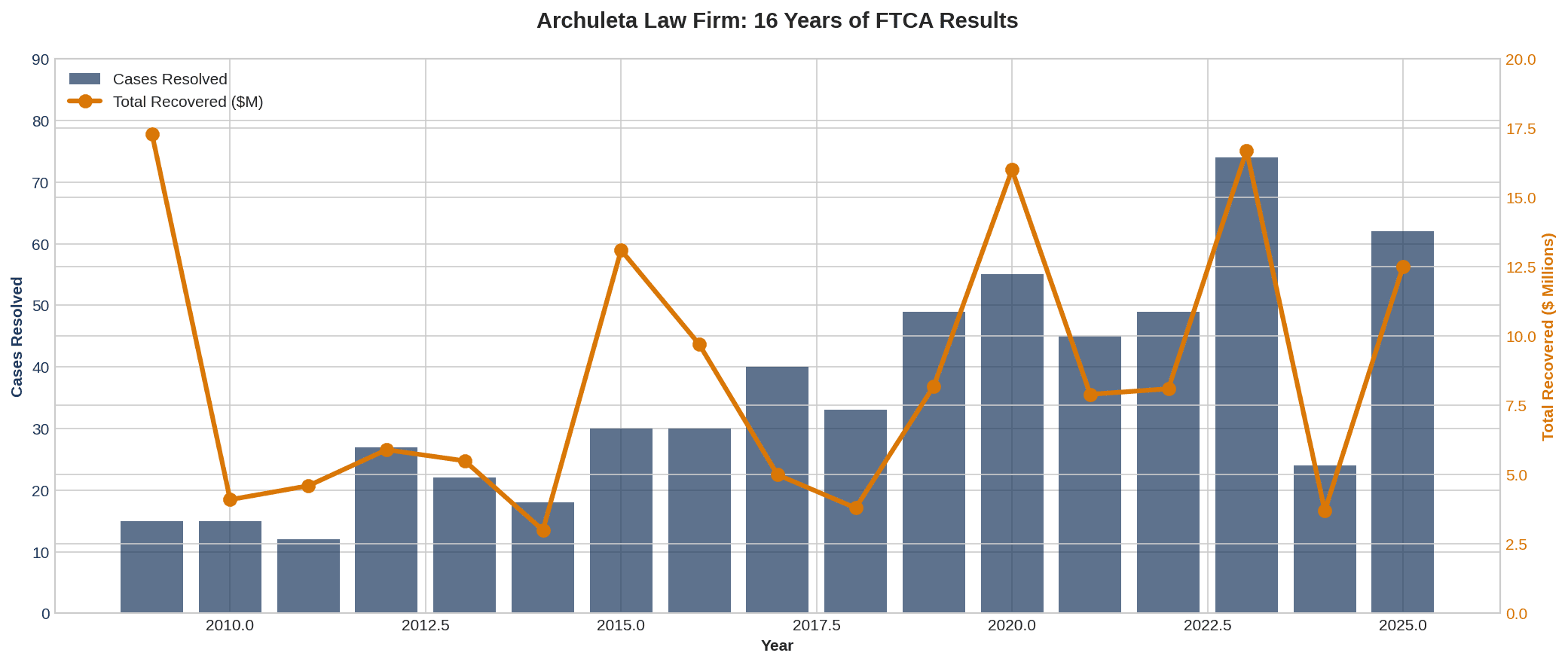
The Archuleta Law Firm has a long history of helping Veterans and their families who have suffered from military medical malpractice and negligence. We have a Doctor-Attorney and Nurse on staff to review your case for free. We have successfully handled hundreds of VA cases under the Federal Tort Claims Act (FTCA) throughout the United States and abroad.
If you or someone you know was injured at a Veterans Hospital or Clinic you may be entitled to a recovery.
Looking for an Experienced FTCA Attorney?
Our doctor-attorney team has recovered $145 million across 600+ federal tort claims cases. See how we can help with your FTCA claim.
Learn About Our FTCA Practice →Frequently Asked Questions — VA Medical Malpractice Lawyers
Can you sue the VA for malpractice or negligence?
Yes. Veterans and their families can sue the VA for medical malpractice or negligence under the Federal Tort Claims Act (28 U.S.C. § 1346(b)), which waives the government's sovereign immunity for injuries caused by VA doctors, nurses, and staff acting as federal employees. You must first present an administrative claim, normally using Standard Form SF-95, within two years after the claim accrues before filing suit in federal court.
Can VA medical malpractice lawyers help me sue the VA?
Yes. VA medical malpractice lawyers who specialize in the Federal Tort Claims Act can file a Standard Form SF-95 administrative claim, negotiate with the VA's legal team, and litigate in federal district court if needed. The Archuleta Law Firm has recovered over $145 million for veterans in VA malpractice cases nationwide.
What is VA medical malpractice?
VA medical malpractice occurs when a Department of Veterans Affairs physician, nurse, or other healthcare provider delivers care below the accepted standard, causing injury or death. Common examples include misdiagnosis, surgical errors, medication errors, and delayed treatment at VA Medical Centers. For negligent acts of federal employees within the scope of employment, the Federal Tort Claims Act (28 U.S.C. § 1346(b)) may provide a remedy. Provider employment status and statutory exceptions must be checked.
Does the Feres Doctrine bar veterans from suing the VA?
No. The Feres Doctrine bars active-duty servicemembers from suing for injuries incident to their military service. It does NOT apply to veterans receiving care at VA facilities. Veterans injured by VA negligence have a clear right to sue under the FTCA — the Archuleta Law Firm has successfully litigated hundreds of such cases.
Can you sue the VA for emotional distress or pain and suffering?
Yes. An FTCA claim can recover compensatory damages — including pain and suffering and emotional distress — to the extent the law of the state where the negligence occurred would allow them against a private doctor (28 U.S.C. § 1346(b)(1)). Punitive damages and pre-judgment interest are barred by 28 U.S.C. § 2674. And under 28 U.S.C. § 2675(b), your lawsuit generally cannot seek more than the sum certain you wrote on the SF-95, so that figure has to be right when you file.
How long do I have to file a VA malpractice claim?
Under 28 U.S.C. § 2401(b), the appropriate agency must receive your administrative claim, normally using Standard Form SF-95, within two years of the date your claim accrued. Missing this deadline almost always bars your claim. Contact a VA medical malpractice attorney immediately to protect your rights.
What settlements do VA malpractice lawyers recover?
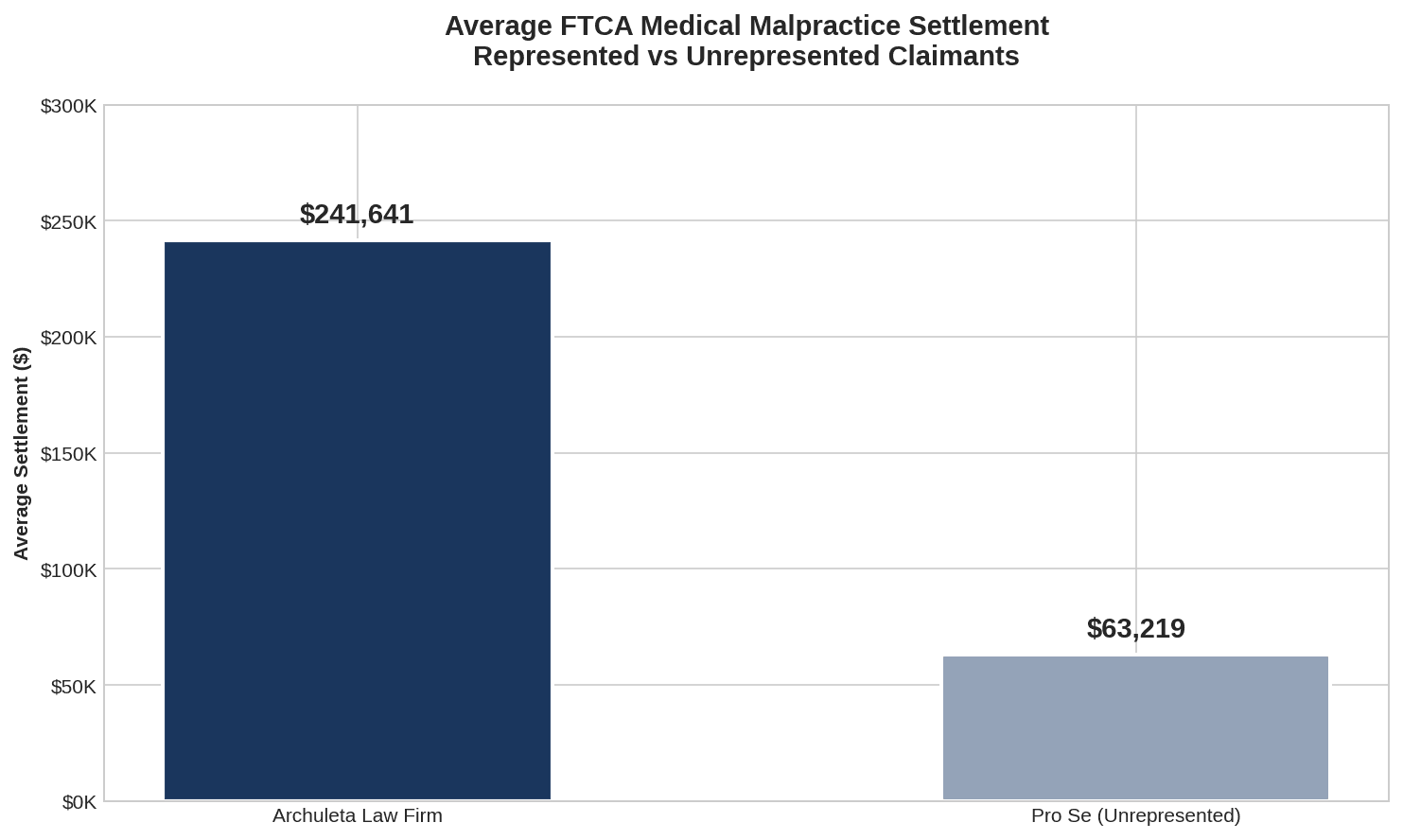
Based on 16 years of Treasury Judgment Fund data, Archuleta Law Firm clients averaged $241,641 in settlements — nearly four times the $63,219 average for unrepresented claimants. Individual results vary by injury severity, liability, and case facts. Our case results distinguish settlements from judgments and the amounts received by clients. These reported averages do not establish a causal effect of representation or predict a new case.
What is the difference between a 38 U.S.C. § 1151 claim and an FTCA lawsuit?
They are two separate remedies for the same VA-caused harm. A 38 U.S.C. § 1151 claim is a VA disability benefits claim decided by the Veterans Benefits Administration; it pays monthly compensation as if the disability were service-connected, and it has no filing deadline. An FTCA claim is a money-damages tort claim against the United States under 28 U.S.C. § 1346(b)(1); it requires presenting a sum-certain Standard Form SF-95 within two years (28 U.S.C. § 2401(b)) and pays a lump sum measured by the law of the state where the care was given. FTCA damages can include pain and suffering, lost earning capacity, and future medical costs, which § 1151 does not pay as separate categories.
Can you file a § 1151 claim and an FTCA claim at the same time?
Yes. Nothing prevents a veteran from pursuing a 38 U.S.C. § 1151 benefits claim and an FTCA malpractice claim for the same VA-caused injury, and neither affects an existing service-connected disability rating. The law does prevent double recovery for the identical harm — an FTCA settlement or judgment may offset § 1151 benefit payments going forward. Because the remedies interact, an attorney can assess the potential benefits and offsets before either claim is resolved.
How do I sue the VA for malpractice?
Present an administrative claim, normally using Standard Form SF-95, to the VA's Office of General Counsel within two years after the claim accrues (28 U.S.C. § 2401(b)). After six months without a decision, you may elect to file suit under 28 U.S.C. § 2675(a). A final written denial generally starts a separate six-month lawsuit deadline from mailing under § 2401(b); agency silence does not start that deadline. An experienced VA medical malpractice attorney can prepare the SF-95, value the claim, and negotiate or litigate on your behalf — attorney fees are capped by law under 28 U.S.C. § 2678.
Were you or a loved one injured at a VA hospital?
Our doctor-attorney team has recovered $145 million for veterans across 600+ FTCA cases. The case review is completely free — and there's no fee unless we win.
Get My Free Case Evaluation →No Fee If No Recovery · Doctor-Attorney on Staff
Get Your Free Case Evaluation Today
Contact our experienced VA medical malpractice attorneys
No Fee If No Recovery